.svg)


Numbers 20:1–13 records one of the most significant and sobering events during Israel’s wilderness journey. The passage describes the death of Miriam, the people's complaint about the lack of water, God's miraculous provision, and Moses’ failure that ultimately prevented him from entering the Promised Land.
The chapter opens with the Israelites arriving in the wilderness of Zin, where they camp at Kadesh. Miriam, the sister of Moses and Aaron, dies and is buried there (v. 1). Her death marks the passing of one of the key leaders of the Exodus generation and serves as a reminder that the older generation is nearing its end after forty years in the wilderness.
Soon the community faces another crisis: there is no water. Instead of trusting God, the people quarrel with Moses and Aaron (vv. 2–5). Their complaints echo earlier rebellions in the wilderness. They accuse Moses of bringing them into a barren place and even suggest that it would have been better to have died with their fellow Israelites in previous judgments. Despite witnessing God's faithfulness for decades, especially as God had miraculously provided water from the Rock at Horeb (Exodus 17:1-7), they continue to display unbelief and dissatisfaction.
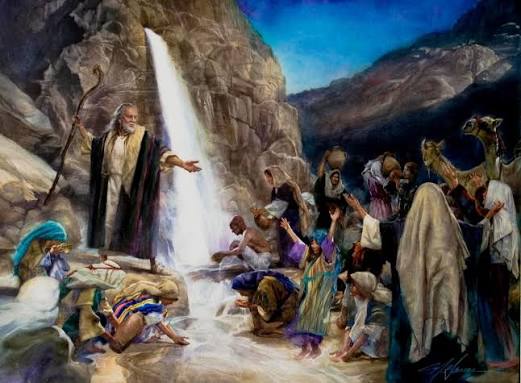
In response, Moses and Aaron go to the entrance of the Tent of Meeting and humbly fall face down before the Lord (v. 6). The glory of the Lord appears, and God gives clear instructions. Moses is told to take his staff, gather the assembly, and speak to the rock before their eyes. God promises that water will come from the rock, providing for both the people and their livestock (vv. 7–8).
Moses takes the staff as commanded and assembles the people. He angrily rebukes the people: "Listen, you rebels, must we bring you water out of this rock?" (v. 10). However, at this crucial moment he departs from God's instructions and strikes the rock twice with his staff (v. 11). Water flows abundantly, demonstrating God's mercy toward the people despite Moses' failure. Rather than simply speaking to the rock, Moses chose to exercise his will against the Lord’s command by striking it.
The central issue in the passage is Moses’ lack of trust in God. "Because you did not trust in me enough to honour me as holy in the sight of the Israelites, you will not bring this community into the land I give them" (v. 12). Moses and Aaron failed to uphold God's holiness before the people. Moses' anger overshadowed God's gracious provision, and his words in v, 10 implied that he and Aaron were the source of the miracle rather than God. Instead of displaying faith and obedience, he acted independently and dishonoured God's holiness.
The sin of thinking that God will bless us and our people merely by our actions is a temptation that all Christian leaders face. The sin is compounded when we deliberately fail to follow God’s commands, thinking that short cuts will do. James reminds us that teachers of the Word will be judged more strictly (3:1). Yet the gracious character of our God is that he often chooses to bless us, despite our sin, as well as chastise us for our disobedience and lack of trust (Proverbs 3:11-12; Hebrews 13:6). In this case, water did flow from the rock, but Moses suffered God’s chastisement in his being prevented from entering the Promised Land. Because he failed publicly, the consequences were also public. God's holiness required that his servant obey his word precisely and so point the people toward God rather than himself.
As the apostle Paul reminds his readers, these things were written down for our instruction, upon whom the end of the ages has come (1 Corinthains 10:11) Paul expands our understanding of this incident by identifying the rock with Christ (1 Corinthians 10:4). Christ is the true source of living water. The physical refreshment that the Israelites received was symbolic of the spiritual refreshment that the Messiah would bring ̶- water that springs up to eternal life (John 4:14). Yet it was only after Jesus had fulfilled his mission, through his death and resurrection, that this living water would flow to believers (Joh 7:37-39).
One might wonder why God told Moses to strike the rock at Horeb at the beginning of Israeli’s journey, but not at Kadesh. The reason is that the Messiah is only struck once. Jesus was bruised for our transgressions, once for all (Hebrews 7:27; 10:10). But now that he has ascended into glory, we speak through our prayers, as Moses should have spoken to the Rock, that the blessings of God might flow.
Moses' inability to enter the Promised Land points forward to the need for a greater leader. A greater Saviour. While Moses could bring Israel out of Egypt, only God's ultimate provision could bring his people into their inheritance. Thus, the passage highlights both the seriousness of sin and the faithfulness of God, who continues to provide for his people despite their failures and those of their leaders. Nonetheless, God’s blessing takes a curious turn, when Moses finally enters the Promised Land on the Mount of Transfiguration, where he meets the Saviour face to face.
Bishop Glenn Davies
Diocese of the Southern Cross